
Solar Power System is Now Need of Time and Its Design Procedure Systematically
Meta Title:
Solar Power System Design – Step by Step Guide | TBBS Solar Power
Meta Description:
Learn why solar power systems are the need of time and discover the complete step-by-step solar system design procedure. Save energy, reduce bills, and go green with TBBS Solar Power.
Keywords:
solar power system, solar energy design procedure, need of solar power, systematic solar design, solar installation, solar power plant design, solar panel system
Introduction
The 21st century is witnessing an energy revolution. Rising electricity bills, growing environmental concerns, and increasing demand for energy independence have made solar power systems the need of the hour. Governments across the globe, including India, are promoting solar energy through subsidies, net metering policies, and tax benefits.
But the real question is: How do you design a solar power system systematically so that it meets your energy needs efficiently?
This blog by TBBS Solar Power Pvt. Ltd. will guide you through:
- Why solar power is essential in today’s time.
- The systematic design procedure of a solar power system.
- Key benefits of going solar.
- Mistakes to avoid while designing and installing solar systems.
By the end, you’ll have a complete roadmap to understand solar power system design and its importance.
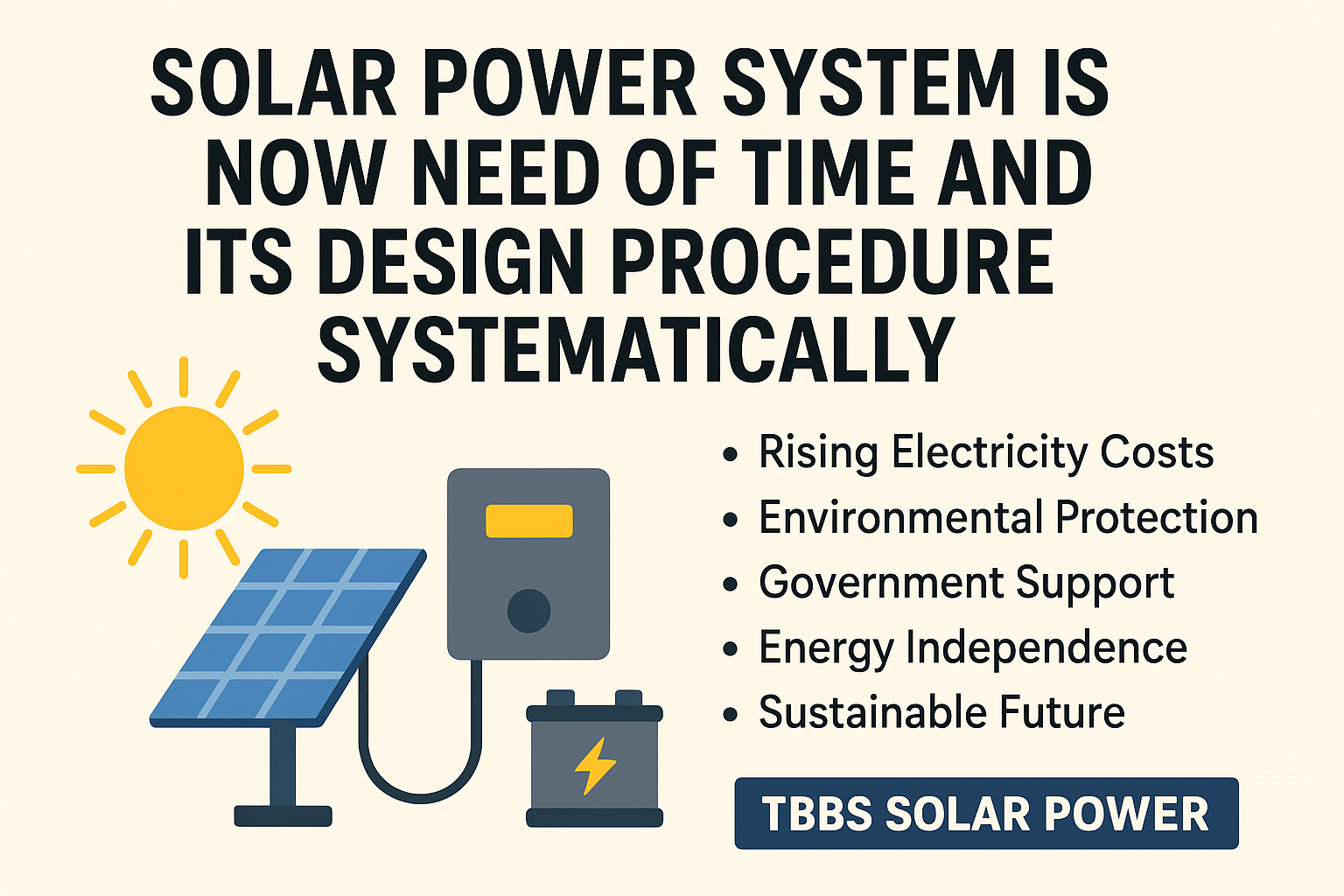
1. Why Solar Power System is the Need of Time
1.1 Rising Electricity Costs
Electricity tariffs are increasing every year due to higher demand and fossil fuel limitations. Solar power offers free electricity for 25+ years after the initial investment.
1.2 Environmental Protection
Solar is a clean, renewable source of energy. Unlike coal or oil, it does not release harmful greenhouse gases. A single solar system can reduce tons of CO₂ emissions every year.
1.3 Government Support
The Indian government provides 40% subsidy for residential rooftop systems up to 3 kW and net metering policies that allow you to sell extra energy to the grid.
1.4 Energy Independence
With a solar power system, homes and businesses can become independent of the unstable power supply and avoid outages.
1.5 Sustainable Future
Switching to solar ensures a sustainable lifestyle and contributes to India’s mission of achieving Net Zero Emissions by 2070.
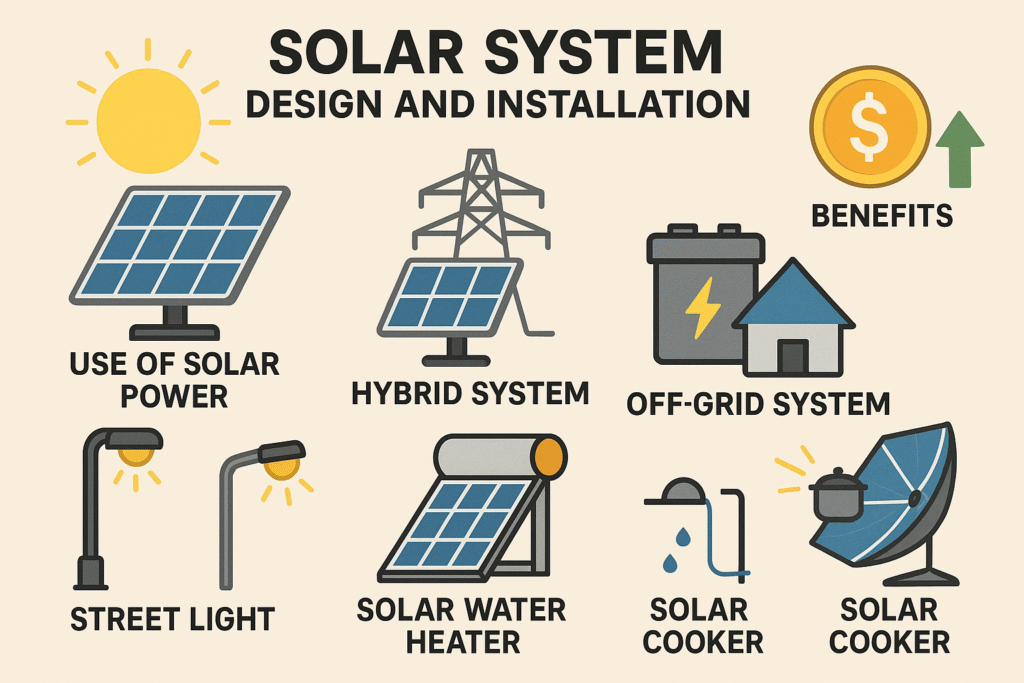
2. Types of Solar Power Systems
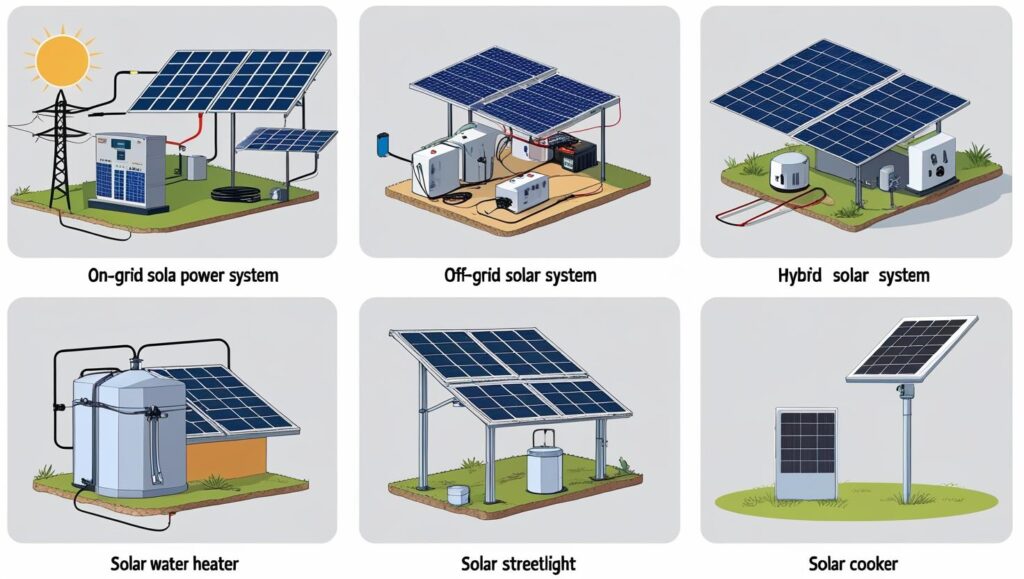
Before understanding the design procedure, let’s look at the different types of solar systems available:
2.1 On-Grid Solar System
- Connected to the government grid.
- Suitable for places with reliable electricity.
- Excess power exported to grid → reduces bills.
2.2 Off-Grid Solar System
- Works independently with battery storage.
- Best for remote areas with no grid access.
- Provides backup during power cuts.
2.3 Hybrid Solar System
- Combination of on-grid + off-grid.
- Stores energy in batteries and also exports to grid.
- Highly reliable but costlier.
3. Systematic Design Procedure of Solar Power System
Designing a solar system requires a step-by-step engineering approach. Below is a systematic design procedure:

Step 1: Assess Energy Requirement
- Collect electricity bills for the last 6–12 months.
- Calculate average daily energy consumption (kWh/day).
- Example: If monthly consumption is 300 units → Daily = 10 kWh/day.
Step 2: Analyze Site Location & Solar Potential
- Measure solar irradiation (sunlight hours) in your area.
- In India, average solar radiation = 4–6 kWh/m²/day.
- Check rooftop strength, direction, and shading.
Step 3: Select Type of Solar System
Choose between on-grid, off-grid, or hybrid based on:
- Grid availability.
- Backup requirement.
- Budget and subsidy eligibility.
Step 4: Calculate Solar Panel Requirement
Formula:
Required kW = Daily Energy Consumption ÷ Average Sun Hours
Example:
- Daily Need = 10 kWh
- Sunlight = 5 hours
- System Size = 10 ÷ 5 = 2 kW
So, a 2 kW solar system is required.
Step 5: Choose Solar Panels
- Monocrystalline Panels – High efficiency, compact, best for limited space.
- Polycrystalline Panels – Cost-effective, slightly less efficient.
- Bifacial Panels – Generate power from both sides.
Step 6: Inverter Selection
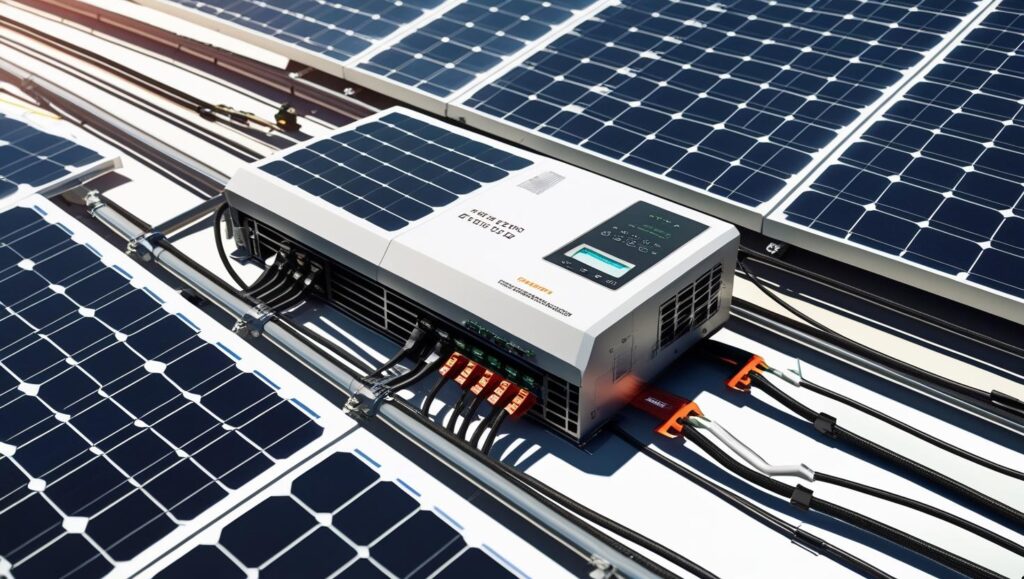
- Converts DC from solar panels to AC for appliances.
- Types:
- String Inverter – Common, cost-effective.
- Micro Inverter – Attached to each panel, higher efficiency.
- Hybrid Inverter – Works with battery + grid.
Step 7: Battery Sizing (For Off-Grid/Hybrid)
Formula:
Battery Capacity (Ah) = Daily Load (Wh) ÷ Battery Voltage × Backup Days
Example:
- Daily Load = 5000 Wh
- Battery Voltage = 48V
- Backup = 2 days
- Capacity = 5000 ÷ 48 × 2 = 208 Ah
So, approx. 200 Ah battery is needed.
Step 8: Mounting Structure & Orientation
- Panels should face South (in India) at an optimal tilt angle = latitude of location.
- Use corrosion-resistant mounting structures.
Step 9: Wiring, Protection & Earthing
- Proper cable sizing to avoid losses.
- Use DC isolators, fuses, surge protection devices (SPD).
- Earthing & lightning arrestor is mandatory for safety.
Step 10: Net Metering & Commissioning
- Apply for net meter with DISCOM (for on-grid systems).
- Inspection by authority.
- System testing & commissioning.
4. Benefits of Systematic Solar Design
✅ Maximum efficiency & performance.
✅ Safety assurance with proper wiring & earthing.
✅ Reduced maintenance cost.
✅ Long system life (25+ years).
✅ Faster ROI (Return on Investment).
5. Common Mistakes to Avoid in Solar Design
❌ Ignoring site survey.
❌ Wrong panel orientation.
❌ Undersized inverter or battery.
❌ Poor quality cabling & connectors.
❌ Not applying for subsidy/net metering.
6. Future of Solar Power in India
- India aims to achieve 500 GW renewable energy capacity by 2030.
- Rooftop solar demand is increasing in residential, commercial, and industrial sectors.
- Solar + storage + EV charging will transform the energy ecosystem.
Conclusion
The solar power system is no longer a luxury but a necessity. It provides free electricity, reduces carbon footprint, and ensures energy independence. However, to achieve maximum benefits, the design procedure must be systematic and professional.
At TBBS Solar Power Pvt. Ltd., we specialize in solar system designing, installation, and maintenance. Whether it’s a 2 kW rooftop system for a home or a 1 MW plant for industries, our team ensures end-to-end solutions with efficiency and quality.
Call to Action
Switch to Solar Today!
Contact TBBS Solar Power Pvt. Ltd. for professional solar system design and installation.
🌐 Visit: tbbssolar.com
📞 Call Us: +91-9654868094
FAQ Section (SEO Optimised)
Q1. Why is solar power system the need of time?
Solar power is essential today due to rising electricity costs, environmental concerns, and the need for energy independence. It offers clean, renewable, and free energy for more than 25 years.
Q2. How do you design a solar power system systematically?
A systematic solar design includes:
- Assessing energy requirement.
- Site analysis & sunlight potential.
- Choosing system type (on-grid/off-grid/hybrid).
- Calculating solar panel capacity.
- Selecting inverter and batteries.
- Designing mounting structure.
- Proper wiring, earthing & protection.
- Net metering & commissioning.
Q3. What are the types of solar power systems?
- On-Grid Solar System – Connected to the utility grid, reduces bills.
- Off-Grid Solar System – Works with batteries, ideal for remote areas.
- Hybrid Solar System – Combines both with backup + grid connection.
Q4. How many solar panels are required for a home?
The number of panels depends on daily energy use. Example: If a home consumes 10 kWh/day and average sunlight is 5 hours, system size = 2 kW (approx. 6 panels of 330W each).
Q5. What is the life of a solar power system?
A well-designed solar power system lasts 25+ years with minimal maintenance. Inverters may require replacement every 10–12 years, while batteries (in off-grid systems) last 5–7 years.
Q6. What government subsidies are available for solar in India?
The Indian government offers up to 40% subsidy for residential rooftop systems up to 3 kW and 20% subsidy for systems between 3–10 kW under the PM-Surya Ghar Yojana.
Q7. How much does a 1 kW solar system cost in India?
The average cost of a 1 kW solar system in India ranges between ₹60,000 – ₹80,000 (before subsidy). After subsidy, the cost reduces significantly.
Q8. What is net metering in solar systems?
Net metering allows you to sell excess electricity generated by your solar panels to the grid. Your electricity bill is adjusted accordingly, helping you save more.